The Stitch in Time: When Americans Knew Exactly What They Were Wearing — Because They Made It Themselves
Open the average American closet today and you'll find it overflowing. Studies consistently show that Americans own more clothing than any previous generation — somewhere between 100 and 150 garments per person, by some estimates. Most of it is cheap. Much of it is rarely worn. Almost none of it was made by the person wearing it, and very few owners could tell you what it's made of, where it came from, or how long it's likely to last.
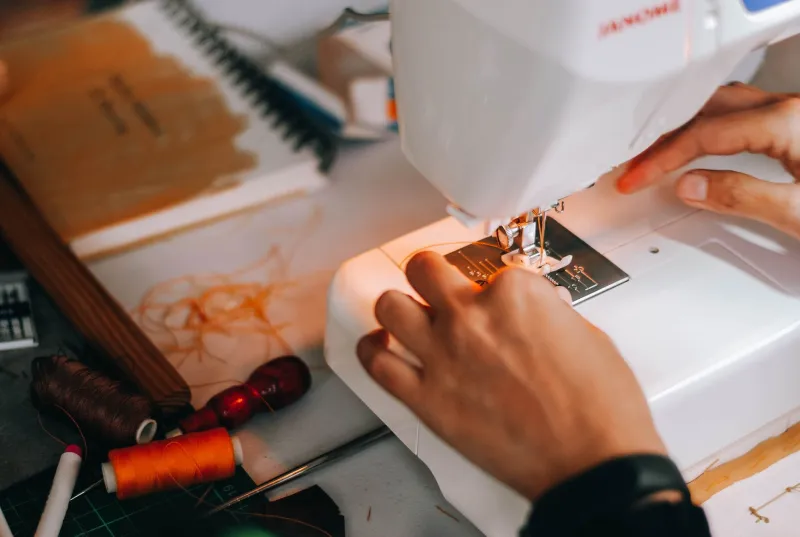
Wind the clock back to 1965, and the picture looks almost unrecognizable. The average American owned far fewer clothes — but understood them far better. A significant portion of those garments had been made at home, by hand, by someone in the household who knew the difference between a French seam and a flat-felled seam, could read a Butterick pattern without instructions, and had strong opinions about the relative merits of cotton broadcloth versus poplin.
Home sewing wasn't a niche hobby. It was a mainstream economic skill — and its disappearance tells us something important about how Americans think about money, value, and the things they own.
The Pattern Industry at Its Peak
At its height in the late 1950s and 1960s, the American home sewing industry was enormous. The Big Four pattern companies — Simplicity, Butterick, McCall's, and Vogue — sold hundreds of millions of patterns annually. Fabric departments occupied significant real estate in department stores like Sears, J.C. Penney, and Woolworth's. Singer sewing machines were a standard household appliance, marketed alongside refrigerators and washing machines as essential domestic equipment.
High school home economics classes taught sewing as a core curriculum subject — not as an elective or an enrichment activity, but as a practical life skill alongside cooking and budgeting. Girls were expected to learn it. By the 1960s, boys were starting to as well, as the curriculum began to broaden. The assumption was that sewing was something adults simply knew how to do, the way they knew how to drive or balance a checkbook.
The economics made sense. A home-sewn dress in 1960 cost a fraction of its ready-to-wear equivalent. The fabric was better quality. The fit was tailored to an actual body, not a standardized size chart. And the garment lasted — because the person who made it chose the materials and controlled the construction, rather than leaving those decisions to a manufacturer optimizing for the lowest possible cost per unit.
The Math Behind the Needle and Thread
This is where the financial dimension of home sewing becomes striking. In the postwar decades, the cost differential between homemade and store-bought clothing was substantial enough to matter to a family budget. A Simplicity pattern cost 25 to 50 cents. Fabric for a dress might run two or three dollars. The total investment — maybe four dollars — produced a garment that would have retailed for fifteen or twenty.
For working-class and middle-class families stretching a paycheck, this wasn't a craft project. It was a financial strategy. Mothers sewed school clothes for children who would outgrow them in a year. Women made their own work wardrobes and church dresses. Men with skilled wives wore custom-fit shirts that would have cost significantly more off the rack.
The skill also created a secondary economy of repair and adaptation. Worn collars were turned. Hems were let down as children grew. Outgrown garments were taken apart and the fabric repurposed. Clothing was treated as a durable asset — something to maintain and extend — rather than a disposable commodity.
How Fast Fashion Unraveled the Whole Thing
The decline of home sewing didn't happen overnight, but its causes are traceable. The 1970s and 80s brought a wave of cheap imported clothing that began to close the price gap between homemade and store-bought. As American manufacturing moved offshore — first to Japan and Hong Kong, then to Bangladesh, Vietnam, and Cambodia — the cost of a mass-produced garment fell steadily.
By the 1990s, the economic argument for home sewing had weakened considerably. A T-shirt at Walmart cost less than the fabric to make one. The time investment — which had always been real — stopped penciling out for families where both adults were working full-time. Home economics was quietly dropped from most school curricula, replaced by other priorities. The fabric departments shrank. The pattern racks thinned out.
Then came fast fashion. Zara, H&M, and eventually the ultra-fast online retailers like Shein completed the transformation. Clothing became almost absurdly cheap and almost absurdly disposable. The average American today buys roughly 65 garments per year and discards about the same number. The price per item has fallen to the point where repair rarely makes economic sense and the quality often doesn't merit it.
The hidden cost of this shift doesn't show up on the price tag. It shows up in landfills — the EPA estimates Americans throw away about 11 million tons of textile waste annually. It shows up in the labor conditions of the factories producing clothes at prices that require wages most Americans wouldn't recognize as livable. And it shows up in the peculiar disconnection millions of people now feel from the objects covering their bodies every single day.
What Was Lost in the Thread
There's a financial literacy argument buried in the history of home sewing that rarely gets made explicitly. When you make something yourself, you understand what it costs — in materials, in time, in skill. You develop an instinctive sense of quality and value that's very hard to acquire any other way. You know what a well-constructed seam looks like. You understand why one fabric costs three times more than another and what that difference means in terms of durability.
That knowledge makes you a better consumer, even if you never sew another stitch. It gives you a framework for evaluating what you're buying, a resistance to the illusion that a $12 blouse represents a good deal when it will dissolve in the wash after six wearings.
Home sewing culture is experiencing a modest revival — driven partly by sustainability concerns, partly by the maker movement, and partly by a generation discovering that the skill is genuinely satisfying in ways that scrolling through an online shopping cart is not. Sewing classes fill up. YouTube tutorials rack up millions of views. Fabric stores that survived the lean years are seeing new customers who are young, curious, and a little surprised by what they're learning.
But it's a revival measured in thousands, not millions. The mainstream fluency that once made the sewing machine as common as the kitchen stove is gone — and with it, a particular kind of economic self-reliance that Americans once took entirely for granted.
We own more clothes than ever. We just understand them less than we ever have.