The Great Knowledge Hunt: When Answering One Question Meant a Day at the Library
Picture this: It's 1985, and you're a high school student assigned to write a paper on the causes of World War I. Your journey to knowledge begins not with typing into a search box, but with convincing someone to drive you to the library.
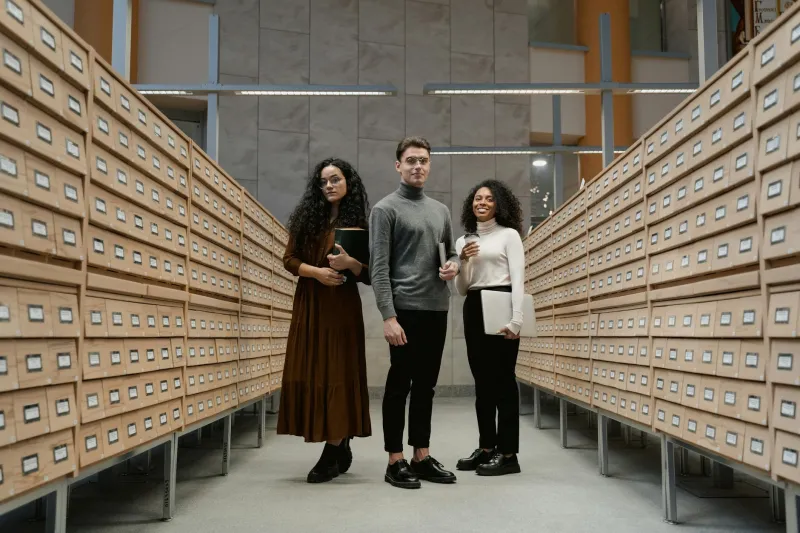
Once there, you'd start at the card catalog—a massive wooden cabinet filled with thousands of index cards, organized by author, title, and subject. Finding "World War I" meant flipping through dozens of cards, jotting down call numbers on scraps of paper, then navigating the maze of book stacks hoping your sources hadn't been checked out by someone else.
If you were lucky enough to find three or four relevant books, you'd claim a table and start the real work: reading entire chapters to find a few usable paragraphs, taking notes by hand because photocopying cost 10 cents per page—real money for a teenager in the 1980s.
The Archaeology of Information
Research in the pre-internet era wasn't just slow—it was genuinely archaeological. Information was buried in physical objects scattered across different locations, and finding it required both strategy and stamina.
Need a newspaper article from 1976? That meant requesting microfilm reels and squinting at a machine that projected fuzzy black-and-white text onto a small screen. The machine was loud, the focus was always slightly off, and you couldn't search for keywords. You had to scroll through weeks or months of daily newspapers, hoping to stumble across what you needed.
Looking for statistics on unemployment during the Great Depression? The reference librarian—if you were brave enough to ask—might direct you to government publications stored in a separate section, or suggest you try the university library across town, which had better resources but required a special pass to enter.
Encyclopedias were the closest thing to instant answers, but they came with built-in limitations. The Encyclopædia Britannica in your local library was probably three to five years out of date by the time you consulted it. The information was authoritative but frozen in time, and cross-referencing between topics meant physically walking to different volumes.
The Social Network of Knowledge
Without search engines, people became search engines for each other. Answering questions often meant calling friends, relatives, or colleagues who might know someone who knew something about your topic.
"My uncle worked at Ford in the 1960s—maybe he remembers something about the Mustang's development."
"My neighbor is a retired teacher—she might have some books about the Civil War."
"The guy at the hardware store seems to know everything about local history."
This human network of information sharing created a different relationship with knowledge. Facts came with stories, context, and personal connections. You didn't just learn what happened—you learned who remembered it happening, and how their memory of events had been shaped by their own experience.
The Weekend Research Expedition
Serious research required planning like a military operation. Students would block out entire Saturdays for library visits, bringing lunch money and a stack of index cards. The smart ones called ahead to make sure the books they needed weren't already checked out.
College students had it slightly better—university libraries stayed open later and had deeper collections—but they faced their own challenges. Popular books were often missing or damaged. Academic journals were bound in heavy volumes that couldn't leave the building. Interlibrary loans could take weeks, and there was no guarantee the book you requested would actually contain what you needed.
The most ambitious researchers would plan road trips to specialized libraries or archives. Want to study local newspaper coverage of a 1950s political campaign? That might mean driving to the state capital and spending a weekend in the historical society's archives, assuming they were open to the public and you could figure out their filing system.
The Texture of Effort
What made pre-internet research fundamentally different wasn't just the time it took, but the physical and mental effort it required. Knowledge had weight, literally and figuratively.
Books were heavy. Walking around a library with an armload of potential sources was exercise. Your back hurt after a day of research, and your fingers were stained with ink from handling old newspapers and taking handwritten notes.
The effort created investment. When finding information was hard, you treated it differently. You read more carefully, took better notes, and thought more deeply about how different sources connected to each other. The scarcity of easily accessible information made each piece feel more valuable.
There was also a genuine thrill in discovery. Finding exactly the right piece of information after hours of searching felt like striking gold. The moment when disparate facts suddenly clicked together into a coherent argument was intensely satisfying in a way that's hard to replicate when answers come instantly.
The Transformation
The internet didn't just make research faster—it fundamentally changed what research means.
Today's students can access more information in five minutes than their 1980s counterparts could gather in five weeks. Primary sources that once required trips to specialized archives are now available as searchable PDFs. Obscure academic papers, government documents, and historical newspapers are all a few clicks away.
But speed came with trade-offs. The ease of finding information changed how we evaluate it. When sources were scarce and hard to obtain, we read them more carefully. When every search returns millions of results, the challenge shifts from finding information to filtering it.
The old system also enforced a kind of intellectual humility. When answering a question required significant effort, people were more comfortable saying "I don't know" or "I'll have to look that up." Now, the expectation is that any factual question can and should be answered immediately.
What We Lost in Translation
The transformation from physical to digital research eliminated many frustrations, but it also changed the texture of learning itself.
The old system created natural breaks for reflection. While walking between library sections or waiting for microfilm to load, your mind had time to process what you'd already found and think about how it fit together. The friction in the system wasn't just an obstacle—it was thinking time.
Serendipitous discovery was also more common in physical libraries. While looking for one book, you'd spot another interesting title on the same shelf. Browsing was built into the process of research, leading to unexpected connections and ideas that pure search-based research rarely produces.
Most importantly, the effort required to gather information made the final product feel more substantial. A research paper represented not just intellectual work, but genuine expedition—you had physically traveled to knowledge and brought it back to share with others.
Today's instant access to information has made us all smarter in some ways and lazier in others. We know more facts but may understand fewer connections. We can answer more questions but spend less time wondering about them. The great knowledge hunt is over, but sometimes the most valuable thing about a treasure isn't finding it—it's the journey you take to get there.