When Learning Required a Quest: How Students Went From Information Hunters to Click-and-Find
Picture this: It's 1985, and your teacher has just assigned a report on the Roman Empire. You have two weeks to complete it, and that timeline isn't generous—it's necessary. Because finding information isn't a matter of typing keywords into a search bar. It's an expedition.
The Great Information Hunt
First stop: the family encyclopedia set. If you're lucky, your parents invested in those 24 volumes of Encyclopædia Britannica that dominated a full shelf in the living room. You flip to "Rome" and find exactly three pages on the entire Roman civilization. It's a start, but your teacher wants five pages, double-spaced.
Next comes the library pilgrimage. You ride your bike or convince a parent to drive you to the public library after school. The children's librarian becomes your research partner, helping you navigate the Dewey Decimal System to find books scattered across multiple sections: 930s for ancient history, 700s for Roman art, 200s for Roman religion.
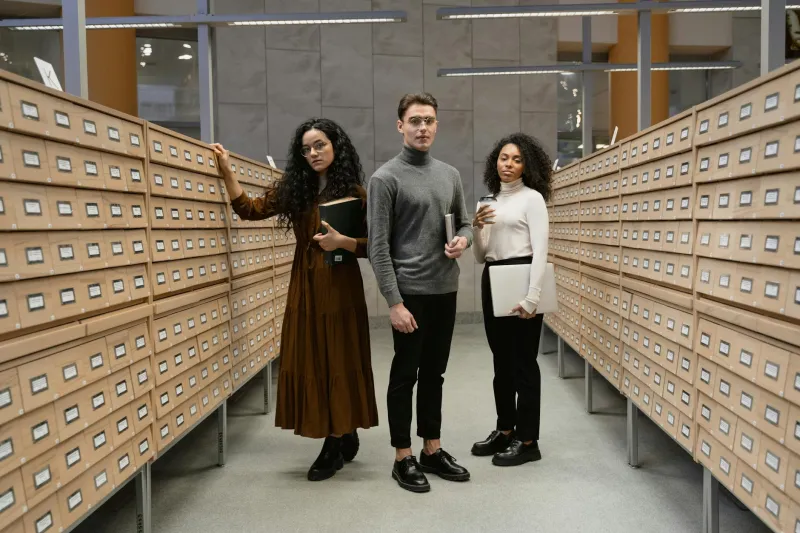
The card catalog—those endless wooden drawers filled with typed index cards—becomes your search engine. You flip through hundreds of cards, looking for anything remotely related to your topic. Each promising title sends you on another treasure hunt through the stacks, hoping the book hasn't been checked out or misfiled.
The Ritual of Discovery
When you finally locate a relevant book, the real work begins. No copy-and-paste exists. Every useful fact gets transcribed by hand onto index cards or notebook paper. You develop a personal shorthand system and learn to identify key information quickly, because you can't take the entire library home with you.
Sometimes you hit the jackpot—a book with exactly the information you need. Other times, you spend an hour reading only to discover the chapter you thought would help actually covers the wrong time period entirely. These dead ends weren't failures; they were part of the process. You learned to evaluate sources, to understand that not all information is equally useful, and to keep searching when the first answer wasn't good enough.
The physical limitations forced a different kind of thinking. With only a few sources available, you had to synthesize information creatively. You couldn't simply compile fifteen different websites' worth of facts. Instead, you had to understand your limited sources deeply enough to construct an original argument from sparse materials.
When Everything Changed
Fast-forward to today's students. That same Roman Empire report now begins with opening a laptop. Google returns 2.8 million results in 0.34 seconds. Wikipedia offers a comprehensive overview longer than any encyclopedia entry ever written. Academic databases provide access to scholarly articles that would have required a university library visit in the past.
The transformation seems entirely positive. Students can access primary sources that were once available only to graduate researchers. They can read multiple perspectives on historical events, compare different interpretations, and find information on obscure topics that wouldn't have merited space in a traditional encyclopedia.
Yet something fundamental changed in how young Americans approach learning. The scarcity that once made information precious also made students more thoughtful about what they sought. When finding facts required effort, students arrived at their sources with specific questions. They had to think before they searched.
The Lost Art of Not Knowing
Today's instant access eliminated the productive struggle that came with information hunting. Pre-internet students learned to sit with uncertainty, to formulate hypotheses while missing key pieces of the puzzle, to build arguments from incomplete information. These weren't bugs in the old system—they were features that developed critical thinking skills.
The physical act of research also created natural breaks for reflection. Walking between library sections, waiting for books to be retrieved from storage, or simply running out of time at the library forced students to process what they'd learned before seeking more. The built-in delays allowed ideas to percolate in ways that continuous scrolling doesn't permit.
Modern students face a different challenge: not finding information, but evaluating the overwhelming abundance of it. They must learn to distinguish credible sources from unreliable ones in an environment where both look equally polished on screen. The old gatekeepers—librarians, publishers, editors—have been replaced by algorithms that optimize for engagement rather than accuracy.
What We Gained and Lost
The democratization of information represents one of humanity's great achievements. A student in rural Kansas now has access to the same primary sources as someone at Harvard. Language barriers dissolve with instant translation. Visual learners can watch documentaries, while auditory learners can find podcasts on virtually any topic.
But we may have traded depth for breadth. The student who once became an expert on three books about Rome might now skim twenty websites without deeply understanding any single source. The patience required to sit with difficult texts, to re-read confusing passages, to think through complex ideas—these skills atrophied when easier alternatives became available.
The Unexpected Lessons
Perhaps most importantly, the old system taught students that learning is often inefficient, sometimes frustrating, and occasionally magical. The serendipitous discovery—finding exactly the right book while searching for something else entirely—can't be replicated by targeted search algorithms. The conversations with librarians, the chance encounters with unexpected topics, the satisfaction of finally locating a hard-to-find source—these experiences shaped how an entire generation understood the relationship between effort and reward in learning.
Today's students complete their homework faster than ever before. But speed isn't the only measure of education's success. In gaining the ability to find any fact in thirty seconds, we may have lost something equally valuable: the understanding that the best knowledge often comes not from the quickest search, but from the willingness to keep looking when the first answer isn't enough.