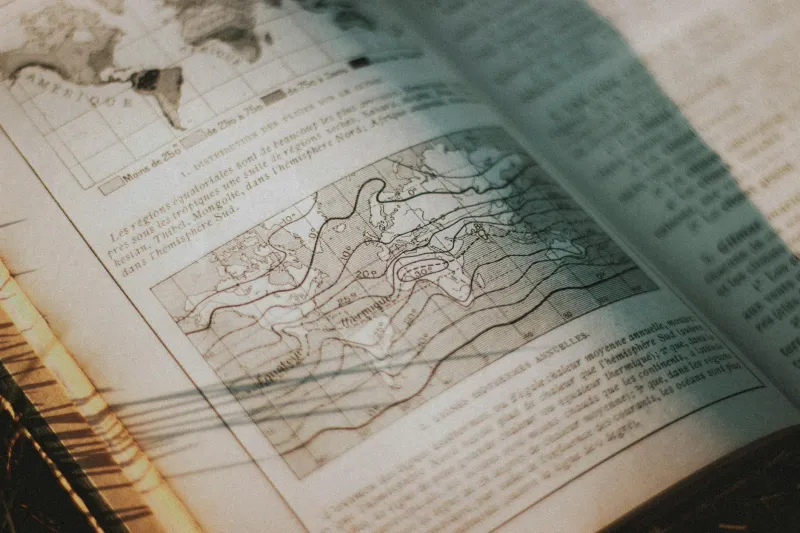
Before the Blue Dot: When Getting Lost Was Part of Getting There
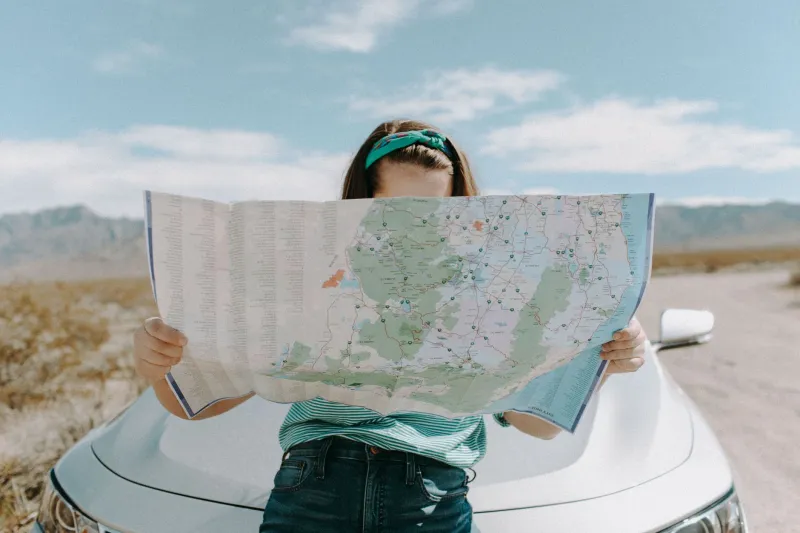
Pull up Google Maps, tap your destination, and the route appears in seconds. A calm voice tells you when to turn. A blue dot tracks your every move. You arrive exactly where you intended, having learned almost nothing about the streets in between.
It is a small miracle that has become so ordinary we've stopped noticing it. And like most miracles of convenience, it came with a trade-off we agreed to without fully reading the terms.
The Map Was a Relationship
Before GPS, before MapQuest printouts, before even the laminated fold-out guides that gas stations used to sell by the register, Americans navigated through a combination of paper maps, local knowledge, and what can only be described as spatial intuition.
Road atlases lived in glove compartments, their spines cracked from repeated use, their margins annotated in pencil with notes like wrong turn here or good diner, exit 14. Planning a road trip meant sitting at the kitchen table the night before, tracing routes with your finger, estimating drive times, identifying towns where you'd stop for gas. You built a mental model of the journey before you ever left the driveway.
That process — unhurried, tactile, slightly imprecise — did something that a GPS route cannot. It gave you the geography before you experienced it. By the time you were on the road, the landscape wasn't unfamiliar. You'd already been there, in a way, in your mind.
Strangers Knew Things the Map Didn't
Ask for directions. Three words that have nearly vanished from American life.
There was a whole social ritual built around them. You'd pull into a gas station in an unfamiliar town, and the person behind the counter — or the guy filling up next to you — would give you directions the way only a local can: Go down past the old Dairy Queen, take a left at the water tower, and when you see the church with the blue roof, you're almost there. Landmarks that didn't appear on any map. Shortcuts that no algorithm would ever suggest. A conversation that lasted three minutes and left you with a small but genuine human connection to a place you'd never been before.
You also got context. The person giving directions might mention that the road you planned to take floods in the rain, or that the restaurant you were looking for closed two years ago, or that there's a better version of it two blocks east. That kind of local intelligence was irreplaceable — and it came bundled with a brief moment of community that you can't get from a touchscreen.
The Accidental Discovery
Here's what GPS is genuinely bad at: surprise.
The algorithm optimizes for efficiency. It wants to get you from Point A to Point B in the least time, with the fewest complications. What it cannot do is recognize that a wrong turn might lead somewhere worth finding.
Every longtime traveler has a version of this story. You missed the exit, or you took a road that looked interesting, or you followed a sign that said scenic route and ignored the estimated time. And you ended up somewhere you never planned to go — a roadside market, a small-town diner, a stretch of coastline that didn't show up in any travel guide. The detour became the destination.
Travel writers have a word for this: serendipity. But it's not really luck. It's the natural result of moving through the world with a degree of openness to the unplanned. GPS, by design, closes that openness. Every deviation is immediately corrected. The system recalculates — and not just the route.
Spatial Memory and What We're Losing
Neuroscientists have been studying this for years, and the findings are striking. The hippocampus — the region of the brain most associated with navigation and spatial memory — is measurably more developed in people who navigate without GPS assistance. London taxi drivers, famously studied for their knowledge of the city's 25,000 streets, showed significant hippocampal growth compared to non-drivers. The brain, it turns out, grows around the challenge of finding your way.
When we outsource navigation entirely to an app, we don't just stop building that knowledge. We stop exercising the cognitive muscle that builds it. Over time, our sense of place — our embodied understanding of how a city is organized, where things are relative to each other, how neighborhoods connect — becomes shallow and fragile. We know how to follow instructions. We don't know where we are.
For a generation growing up entirely within the GPS era, this isn't a loss they're aware of. They've never had the alternative. But for anyone who once knew a city through the soles of their shoes and the creases of a map, the difference is palpable.
Efficiency Isn't the Same as Experience
None of this is an argument for throwing your phone out the window. GPS has made driving safer, reduced the frustration of navigating unfamiliar cities, and probably saved more than a few marriages during family road trips. The practical gains are real.
But at Beyond The Index, we're interested in what the metrics miss. Efficiency metrics don't capture the feeling of knowing a city — genuinely knowing it, the way you know your own neighborhood. They don't measure the value of a conversation with a stranger at a crossroads, or the memory attached to a wrong turn that turned out right.
The blue dot is always exactly where you are. But it has no idea where you've been.