Pin the Tail, Eat the Cake, Go Home: The Birthday Party Before It Became a Production
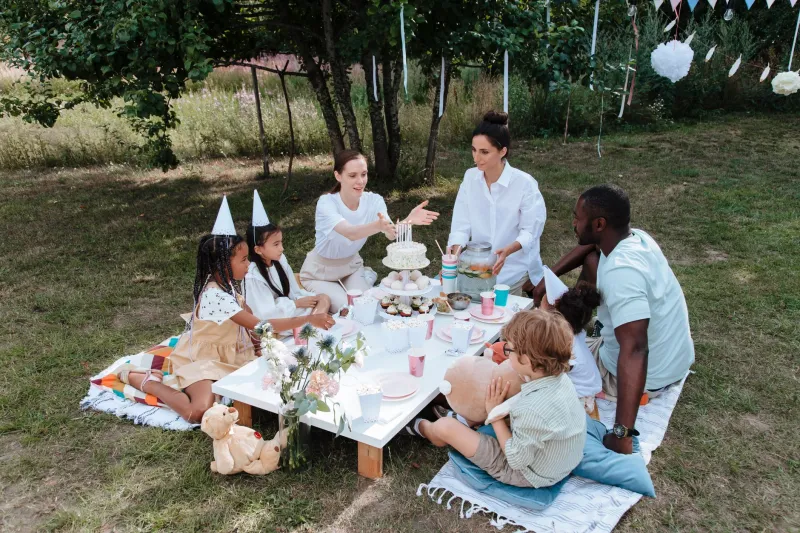
Let's say it's 1983. Your kid is turning seven. Here's the plan: you call a few neighbors, maybe send a hand-written note home with the kids in the class. You buy a box of cake mix and some balloons from the grocery store. You move the furniture in the living room, put out some paper plates, and fill a bag with cheap prizes from the drugstore. The kids show up, they destroy the cake, someone cries over a game of musical chairs, and by 4 p.m. it's over. Total cost: maybe forty dollars. Planning time: an afternoon.
Now fast-forward to today. That same birthday is likely to involve a venue booking made three months in advance, a theme chosen from a shortlist presented to the child like a product pitch, custom invitations designed on Canva or ordered from Etsy, a professional cake from a specialty bakery, a goody bag that costs more per child than your parents spent on the whole party, and at least one parent who has built a Pinterest board with seventeen saved ideas that will only partially survive contact with reality.
Something changed. And it's worth asking what, exactly, and whether any of it actually made childhood better.
The Backyard Was the Venue
For most of the 20th century, birthday parties for children were neighborhood events — informal, local, and almost entirely improvised. They happened in backyards, living rooms, or church halls. The guest list was drawn from whoever was close by. The entertainment was whatever you could organize with a rope, a yard, and a group of kids who didn't need much prompting to have a good time.
Games like pin the tail on the donkey, freeze tag, or a simple treasure hunt required nothing more than some preparation and a few minutes of adult direction. After that, the kids ran the show themselves. Parents were supervisors, not event coordinators. The birthday child was the center of attention in a simple, uncomplicated way — not because the aesthetic was perfect, but because everyone they loved had shown up.
Homemade cakes were the standard, not the exception. The fact that the frosting was slightly uneven was part of the charm. Nobody photographed it for an audience. It was made, it was eaten, it was gone.
Where the Escalation Came From
The shift toward more elaborate children's parties didn't happen because parents suddenly loved their children more. It happened because of a convergence of cultural and commercial forces that gradually raised the baseline of what a birthday was supposed to look like.
The rise of party supply chains in the 1980s and '90s made themed decorations cheap and widely available. Chuck E. Cheese and similar entertainment venues offered a turnkey option that removed the logistics burden from parents — and introduced the idea that a venue was something a child's birthday required. By the time the internet arrived, the comparison engine was fully operational. You could see what other parents were doing, and what other parents were doing was a lot.
Pinterest, which launched in 2010, arguably did more to transform the birthday party than any single product. It gave parents access to an infinite gallery of beautifully styled parties, which had the effect of making every ordinary living room feel inadequate by comparison. Instagram finished the job. When the party becomes content — something to be photographed and shared — the aesthetic stakes rise dramatically. Suddenly the cake isn't just for eating. It's for the grid.
The Parent Is Now the Vendor
One of the more telling shifts in the modern birthday party is who does the work and who it's really for.
In the old model, the party was largely assembled by parents with whatever they had on hand. The effort was real but low-stakes. If the streamers didn't match the plates, nobody noticed or cared. The children certainly didn't.
Today, a significant portion of birthday party planning involves managing the expectations of other parents — not just the children attending. The presentation of the party has become a form of social signaling. The goody bags, the catering, the entertainment package — these communicate something about the family's resources, taste, and investment in their child's experience. Whether that was anyone's intention, it's become the reality.
The children themselves, meanwhile, are often less engaged with the production than the adults organizing it. Studies on childhood happiness consistently find that kids value presence over presentation. They want their friends there. They want to run around. They want cake. They are, in this regard, remarkably easy to please — far easier than the event industry that has grown up around them would suggest.
What the Simpler Version Got Right
There's a case to be made that the old-school birthday party, for all its informality, was actually better calibrated to what children need.
Unstructured play — the kind that naturally emerges when you put a group of kids in a backyard with minimal adult direction — is developmentally valuable in ways that organized entertainment isn't. Kids negotiate rules, resolve conflicts, invent games, and build social skills in real time. A professional entertainer running a scripted performance is fun, but it doesn't create the same kind of friction and growth.
There's also something to be said for the absence of pressure. When the party isn't a production, the birthday child isn't performing for a camera or trying to match a vision board. They're just having a birthday. Which is, when you think about it, the whole point.
The Number Doesn't Change
A child is still turning seven. That number doesn't get more significant because the cake cost two hundred dollars or because the invitations were letterpress printed. The joy of the day — the feeling of being celebrated, surrounded by people who showed up for you — doesn't scale with the budget.
The backyard parties of the past weren't inferior. They were just honest about what a birthday actually is: a day to feel special, eat something sweet, and play with your friends until someone's mom says it's time to go home. That was enough then. It probably still would be now.