The Glass of Milk That Could Kill You: America's Forgotten War Over Pasteurization
The Glass of Milk That Could Kill You: America's Forgotten War Over Pasteurization
In the early 1900s, summer was the season American parents feared most. Not for the heat, not for the disruption to school schedules — but because summer was when the milk went bad fastest, and bad milk meant sick children, and sick children in that era meant something that modern parents can barely bring themselves to imagine.
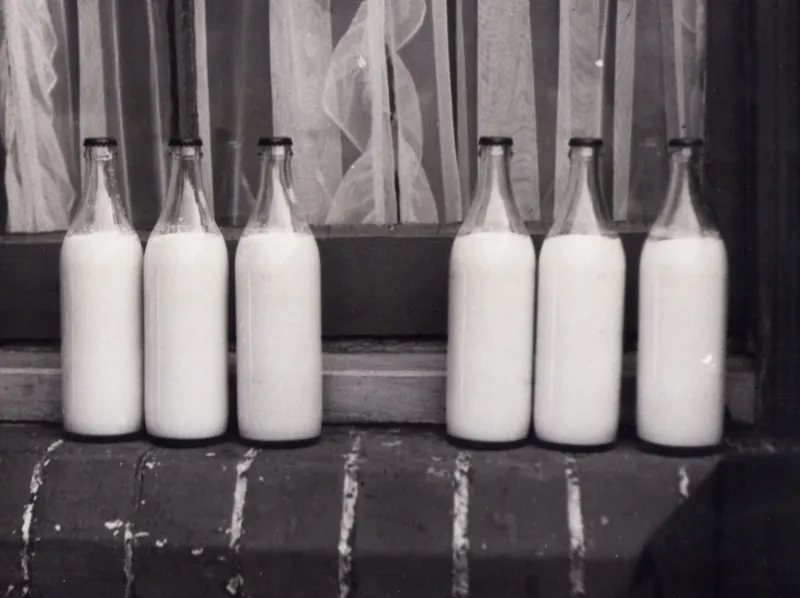
Infant mortality rates in American cities during the late nineteenth century were staggering. In New York City, roughly one in five children born alive didn't survive to their first birthday. A significant share of those deaths traced back to a single, wholesome-looking source: the family milk bottle.
 Photo: New York City, via media.architecturaldigest.com
What Was Actually in That Glass
Raw milk, straight from the cow and delivered warm to urban doorsteps, was a near-perfect vehicle for bacterial transmission. Tuberculosis. Scarlet fever. Typhoid fever. Diphtheria. Brucellosis. These weren't rare outcomes — they were routine features of the American milk supply in an era before refrigeration was widespread and before anyone fully understood germ theory.
The problem was structural. Urban dairies in the 1880s and 1890s were often nightmarish operations. Cows were kept in cramped, filthy conditions, sometimes fed distillery slop — the waste grain left over from alcohol production — which weakened them and degraded the quality of their milk. Workers with no sanitation training handled the milk from udder to bottle. Delivery happened in open containers on warm mornings. By the time that glass of milk reached a child's lips, it had passed through a dozen potential contamination points.
The science was already there. Louis Pasteur had demonstrated in the 1860s that heating liquids to a specific temperature killed harmful bacteria without destroying the product. Applying that principle to milk — heating it to around 145 degrees Fahrenheit for thirty minutes, or a higher temperature for a shorter period — would eliminate the pathogens that were quietly killing American children in enormous numbers.
 Photo: Louis Pasteur, via picx.zhimg.com
The resistance to doing so was fierce, prolonged, and in retrospect, difficult to comprehend.
The Coalition Against Clean Milk
The opposition to mandatory pasteurization wasn't fringe. It was organized, politically connected, and drew from sources that lent it a veneer of credibility.
Dairy farmers argued that pasteurization would destroy their industry by implying their product was dirty. They weren't wrong about the implication — it was dirty — but the economic anxiety was real, and farmers had political power in early twentieth-century America. Pasteurization equipment cost money. Compliance meant inspection. Inspection meant exposure.
Some physicians joined the opposition, arguing — with almost no supporting evidence — that heating milk destroyed its nutritional value or its capacity to support infant health. The "raw milk is more natural" argument is not a modern invention. It was being made, earnestly and loudly, while children were dying of tuberculosis contracted from the family breakfast table.
Religious and philosophical objections surfaced too. There was a persistent strain of thought in American culture that equated "natural" with "safe" and viewed human intervention in food production as inherently suspect. Pasteurization, to this line of thinking, was tampering — an industrial solution to a problem that could be addressed by simply buying milk from cleaner farms.
The cleaner farms argument was genuine but practically useless. Certifying farms as clean was expensive, inconsistent, and nearly impossible to scale across the chaotic urban milk supply chains of the early 1900s.
The Reformers Who Wouldn't Quit
The push for mandatory pasteurization was led, in large part, by public health reformers who were watching children die in numbers that should have made the political case obvious — and discovering that obvious wasn't enough.
New York City's health department, under figures like Dr. S. Josephine Baker, became a national leader in fighting for safe milk. Baker's work in reducing infant mortality in New York's most crowded neighborhoods was extraordinary: through a combination of public education, milk stations that provided clean pasteurized milk to poor families, and relentless political pressure, she helped drive the city's infant death rate down dramatically in the early decades of the twentieth century.
 Photo: Dr. S. Josephine Baker, via 1.bp.blogspot.com
Chicago, Boston, and other major cities fought their own versions of the same battle. Progress was city by city, ordinance by ordinance, with dairy interests fighting every step. It wasn't until the 1940s that pasteurization became effectively universal across the American milk supply — decades after the science was settled and the death toll was undeniable.
What the Numbers Actually Looked Like
Before pasteurization was widespread, milk-borne diseases accounted for roughly 25 percent of all foodborne illness outbreaks in the United States. Bovine tuberculosis — transmitted through raw milk — infected hundreds of thousands of Americans annually. The CDC estimates that before pasteurization, raw milk and raw milk products caused a disproportionate share of all dairy-related illness and death.
After pasteurization became standard, those numbers collapsed. Scarlet fever, once a terrifying killer of children, became manageable. Typhoid transmission through milk effectively disappeared. The infant mortality rate dropped sharply over the mid-twentieth century, with safer milk supply playing a meaningful role alongside other public health improvements.
The Argument That Refuses to Die
What makes this history worth revisiting now is that the debate never fully ended. The raw milk movement of the 2000s and 2010s recycled many of the same arguments that dairy farmers and skeptical physicians made in 1910: that pasteurization destroys beneficial enzymes, that raw milk builds immunity, that the natural product is superior to the processed one.
Some of those claims have more scientific backing than others. But the baseline question — is raw milk meaningfully more dangerous than pasteurized milk — has a clear answer. The CDC tracks raw milk outbreaks consistently, and the data is not ambiguous: raw milk causes illness at dramatically higher rates than pasteurized milk, and the pathogens involved include some serious ones.
The difference is that today's raw milk debates happen in a context where almost nobody has living memory of what uncontrolled milk-borne disease actually looked like at scale. We've forgotten the body count that made pasteurization so urgently necessary. And when you forget why a safety measure exists, it becomes much easier to argue it was never needed in the first place.
That forgetting is its own kind of danger.